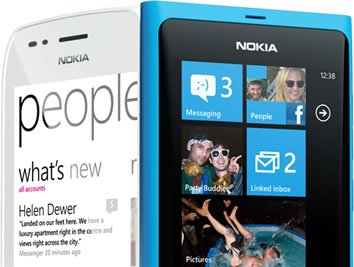
NOKIA ACCIDENTALLY LEAKS AN INTERNATIONAL WHITE LUMIA 900?

Did Nokia accidentally reveal a white Lumia 900 on Facebook?

Next iDevice from apple

With all the iDevices found in the market from iPhone, iPod Touch, iPads to Macbooks, do you think there’s still lacking?

The future of smartphones from the world of concept phones

Ever since the birth of science fiction in the 19th century people have enjoyed predicting what the future holds for technology.

Friday, 16 December 2011

Know what the world searched for in 2011


Google has released Zeitgeist 2011, a year-end look at the most popular search terms throughout the year. The 11th annual report analyzes the hottest and fastest rising queries in a variety of categories across the world.
For 2011, the most popular global search was for Rebecca Black and her YouTube hit song “Friday”. The music video launched the 13-year-old to celebrity status after it received over 167 million views. Songstress Adele also made the top 10 list at number seven. Other celebrities rounding out the top spots include Ryan Dunn, Casey Anthony and Steve Jobs.
Nearly half of the top searches were related to technology in some form or fashion. Google+ was the second most searched term, followed by Battlefield 3 at number five, iPhone 5 and number six and the iPad 2 at number 10.
Natural disasters, including Hurricane Irene in the US and the earthquake and tsunami in Japan were also highly searched terms. The Japanese earthquake showed up on lists from almost half of the countries in the 2011 Zeitgeist. Unsurprisingly, “earthquake” topped Japan’s fastest rising list and “TEPCP”, owners of the Fukushima power plant, became the first non-Latin query to ever make the global fastest-rising list. In the US, the top searches related to charitable giving were about assisting Japan.
Google improved the Zeitgeist to make it easier to compare terms across all categories and added detailed infographics as well as a video overview of terms that captivated the world in 2011.

Fastest network data transfer in the world – 186 GB/s


research, science, networking, lhc, records, physics, caltech, cern, physicists, 186gbps
Scientists at Caltech managed to squeeze 186Gbps of data through a fiber optic network link between Victoria, B.C and Seattle, WA. This achievement marks the highest speed transfer ever over a long-range network, breaking the previous record of 119Gbps which was also set by the same Caltech team.
The impressive figure was not just data sent one way, but rather the sum of simultaneously sending 86Gbps of data to the University of Victoria and receiving 100Gbps at the Washington State Convention Center. While the 186Gbps link was not fully bi-directional, the highest possible transfer in any given direction was still a whopping 100Gbps, a limit imposed by the networking switches used. The total amount of data transferred during the demonstration was 4.42 petabytes.
The team utilized a cluster of ten cutting edge, pre-production Dell servers with PCIe-3 based network cards. The computers were stuffed with SSDs and joined together between cities via a "state of the art" fiber optic network connected to multiple 100Gbps network switches. Some more details about the setup can be found here.
Caltech hopes their new achievement can be applied to CERN's Large Hadron Collider. The LHC is a particle accelerator where scientists can take small amounts of matter, accelerate them to 99.9% the speed of light and collides the matter together in hopes that the resulting "explosion" reveals clues about our universe. During these tests, a massive amount of particle data is generated and that data needs to be collected. The team hopes that their progress in the field of high-speed communications will help high-energy physicists collect, send and receive this tremendous amount of data with greater ease.

Thursday, 15 December 2011

Google releases Chrome 16 stable with multiple account sync


Google has released the sixteenth version of Chrome into the stable channel, introducing the ability to create and synchronize multiple profiles for a single instance of the popular web browser. The feature will be particularly useful for anyone who shares their computer with others -- at home, for example -- as they'll be able to keep their bookmarks, apps, settings, extensions and history separate from everyone else's.
To create a new profile users must head to preferences / personal stuff and click "Add new user". A new instance of Chrome will appear with a badge and a random name that can be edited to whatever you like. A clickable label in the top-right corner of your browser windows will show which account is currently in use and clicking on the label enables users to switch between accounts.
In a post at the official Google Chrome blog, software engineer Tim Steele notes that adding new users to Chrome isn't intended to secure your data against other people using your computer. Profiles aren’t password-protected so it just takes a few clicks to switch between users.
Besides adding support for multiple profiles the latest release of Chrome also addresses 15 high- and medium-risk vulnerabilities. The high-risk security flaws include an URL bar spoofing bug, use-after-free errors, out of bounds writes in the V8 JavaScript engine and a buffer overflow in PDF font handling. As part of its Chromium Security Rewards program, Google paid external researchers a total of $6,000 for reporting the bugs.

Google's official Siri fighter codenamed Majel


Since the release of Apple's voice-activated assistant, there have been countless "Siri-killers", "Siri-like apps" and "We already had Siri" headlines littering the web. However, Google's Android may finally provide a worthy analogue to Apple's attempt at understanding natural language. 
Codenamed Majel (may-jell), the new system will supplant Android's current system, Voice Actions, early in 2012. The new technology promises to interpret your everyday language instead of relying on Voice Actions' rigid verbal command syntax. 
In an interview regarding Ice Cream Sandwich, Google Android director, Matias Duarte noted, "Our approach is more like Star Trek, right, starship Enterprise; every piece of computing surface, everything is voice-aware." hinting at a future where voice activation is ubiquitous among devices.
If you happen to be a Star Trek nerd, the name choice is a curious one. As fellow trekkies may know, Majel Barrett-Roddenberry was the wife of Star Trek creator, Gene Roddenberry. She portrayed Nurse Chapel in the original series and Lwaxana Troi in later shows (namely TNG) but perhaps her most recognizable role was that of the Enterprise computer. Majel (the actor) did voice acting for the ship's computer throughout most of Star Trek's history, including the 2009 movie.
Few details are known, but it is safe to say Google has the means to make something amazing. Where Siri was based on DARPA research from decades passed, Majel could be based upon many years of voice data analysis from Google's 411 and Voice services. The company also acquired Phonetic Arts in 2010, a business which specialized in human-like voice synthesis. Together, these things lay the foundation for an impressive virtual assistant experience.
Much like Siri, the initial release of Majel is expected to be somewhat less sophisticated than the final product. The software will not feature natural language commands at first, although it should still provide answers to your questions by utilizing Google's own services. Controlling the actions of your phone and its applications by speaking in everyday language will be coming at a later date.

Demo Windows Phone on your iPhone or Android handset


iphone, android, windows phone, html5, demo, mango, demo windows phone
Have you ever been curious about a new phone but didn’t want to have a sales associate hanging over your shoulder while you checked it out? If so, you’re in luck as Microsoft has released a Windows Phone 7.5 Mango ‘trial’ that you can access from your iPhone or Android smartphone without leaving the house.
The semi-guided tour can be accessed by visiting http://aka.ms/wpdemo with your phone’s browser. The HTML5-based site mimics the look and feel of Windows Phone on your device. Once started, you can select multiple different demos including People, Family, Pictures, Local Scout, Calendar, Outlook, Messaging and Phone.
While exploring each category, a blue dot will appear that prompts you where to go to reach the next step and ultimately the end of each section. You are free to ignore the prompts and explore at your own leisure but ultimately you will need to follow along to complete the task.
At the end of the demo users are prompted to share their experience via social networks like Facebook and Twitter or go directly to a list of available Windows Phone handsets. Those phones include the Samsung Focus S, HTC Titan, Samsung Focus Flash, HTC Radar 4G, HTC Trophy, HTC Arrive, Nokia Lumia 800, Nokia Lumia 710, HTC HD7 and the Samsung Focus.

A closer look at Nokia's Lumia Windows Phones


nokia, windows phone, smartphone, windows phone 7.5, nokia lumia
Last week was Nokia's turn to show what's coming from the Finnish company at their own Nokia World 2011 expo. While they were keen to unveil prototypes that included a phone with a screen that can be twisted and flexed, the company's next big thing was undoubtedly the official launch of the Lumia Windows Phones.
The Lumia 800 will be Nokia's first Windows Phone 7.5 smartphone. It shares many attributes with the MeeGo-powered N9, including its single-piece polycarbonate construction -- in fact both phones are nearly identical on the outside. The 800 is powered by a single-core, 1.4GHz processor, 16GB of internal storage, 512 MB of RAM, an 8-megapixel camera, 720p video capture and a 3.7-inch, WVGA resolution ClearBlack AMOLED display. 
It's clear that Nokia wants to play to its strengths when they opted to go after the European market first, however it's also true that for Windows Phone to succeed and become a widespread platform that can attract developers en masse, they need a reputable global partner that can scale in the same order of magnitude as competitors Samsung, Motorola, Apple, and others who have leveraged support for the Android and iOS ecosystems.
Meanwhile, Windows Phone has HTC and Samsung, but neither is fully committed to advance the platform. Nokia was meant to be that partner, especially after they essentially abandonded the MeeGo operating system. On that same note, Microsoft will hold a Windows Phone event next November 7th, where hopefully we will learn more about their U.S. plans and Nokia's involvement or lack thereof.
Whether users will be willing to drop an iPhone or say, a Galaxy S II, for the Lumia 800 and Windows Phone is hard to predict. If you watch the video above you might notice there's something iconic about    Nokia's WP 7.5 flagship handset. So you could say the hardware and software is there, but the platform is still in its infancy by sheer usage numbers and that translates into limited app support in comparison to Android, or let alone Apple's app store.

The Nokia Lumia 710 is the second WP 7.5 smartphone announced by the manufacturer. It is a lower-cost model, which can be witnessed by its cheap feel when compared to the fancier 800 model. The Lumia 710 has a 3.7-inch ClearBlack TFT LCD display and is powered by the same 1.4GHz Snapdragon processor. Both phones will go on sale in France, Germany, Italy, the Netherlands, Spain and the UK in November, and in Hong Kong, India, Russia, Singapore and Taiwan by the end of the year.

MIT develops ultra-fast camera that captures the motion of light


In everyday life, we take for granted how instantaneous light seems. In reality though, the photons which make up the light we see travel around 186,280 miles per second. Researchers at MIT have developed a digital camera capable of capturing data so quickly that we can actually watch light itself unfold in slow motion. Researchers claim the camera captures roughly one trillion frames per second worth of visual data, yet it still has its limits.
The camera is part high-technology and part technique. The equipment itself consists of a "streak" camera, some cleverly used mirrors and a titanium sapphire laser that generates extremely brief (ie. one femtosecond) pulses of light.
The streak camera utilizes an array of 500 sensors which capture light at an astonishing rate of one-trillion times per second. The camera was originally designed to collect information regarding wavelengths of light, a common way to determine the material composition of an object. Different molecules absorb unique wavelengths of light and reflect others. This reflected light is what we call color. Rather handily, scientists can identify molecules by analyzing their spectral density and this camera allows them to do just that.
Because of how the camera requires multiple shots of the same exact scene, objects must remain completely still. The camera does not capture an entire scene all at once but rather, it collects one-dimensional strips of data which can be used to determine the departure and arrival of photons in the scene. This data is algorithmically compiled together to recreate a two-dimensional video with astonishing results. Unfortunately, the compilation of this data can take hours of post-processing and the process itself is impractical for use at home, making this unlikely to replace your digital video camera any time soon.
Despite of the obvious drawbacks as a consumer product, researchers claim such equipment and techniques -- in the future -- could allow for studio-quality lighting in virtually any environment and any light source or medical imaging. For now though, the device is useful to scientists as they are better able to study the propagation of photons on scales of speed compatible with human perception.